 Inner garden of Palacio E Convento De Mafra with a fountain at the centre of the garden.

Inner Garden Of Palacio E Convento De Mafra, Portugal
Inner garden of Palacio E Convento De Mafra with a fountain at the centre of the garden.

Centre Piece Of Palacio E Convento De Mafra, Portugal
 The Mafra National Palace is a monumental Baroque and Italianized Neoclassical palace-monastery located in Mafra, Portugal, some 28 kilometres from Lisbon. Its dimensions are so huge that it dwarfs the city. The palace, which also served as a Franciscan monastery, was built during the reign of King John V (1707–1750), in consequence of a vow made by the king in 1711, who promised to build a convent if his wife, the Queen Mary Anne of Austria, gave him descendants. The birth of his first daughter, the princess Barbara of Braganza, made the king initiate the construction of the palace. It was conveniently located for hunting in the nearby forests, and was usually a secondary residence for the royal family.
 This vast complex is among the most sumptuous Baroque buildings in Portugal and one of the biggest buildings constructed in Europe in the 18th century. The palace was built symmetrically from a central axis, occupied by the basilica, and continues lengthwise through the main façade until two major towers. The structures of the convent are located behind the main façade. The building also includes a major library, with about 40,000 rare books.
The basilica is decorated with several Italian statues and includes six historical pipe organs and two carillons, composed of 92 bells.
The exact site was chosen in 1713 and purchased in 1716. Construction began by the laying of the first stone on November 17, 1717 with a grand ceremony in the presence of the king, his entire court and the Cardinal Patriarch of Lisbon.
Initially it was a relatively small project for a friary of 13 Capuchin friars, who were to observe strict poverty. However, when the flow of gold from Brazil started to arrive in Lisbon in abundance, the king changed his plans and announced the construction of a sumptuous palace[1] along with a much enlarged friary. This immense wealth allowed to king to be a generous patron of arts.
He appointed a German goldsmith Johann Friedrich Ludwig (called by the Portuguese : João Frederico Ludovice) as his architect. Ludwig had studied architecture in Rome and knew contemporary Italian art. The extent of Ludwig's responsibility is unclear, as several other architects were involved in this project: the Milanese builder Carlos Baptista Garbo, Custódio Vieira, Manuel da Maia and even his own son António. However the application of the same architectural style over the whole building suggests the work of Ludwig as the head-architect in charge of the Royal Office of Works (Real Obra).
Construction lasted 13 years and mobilized a vast army of workers from the entire country (a daily average of 15,000 but at the end climbing to 30,000 and a maximum of 45,000), under the command of António Ludovice, the son of the architect. In addition 7,000 soldiers were assigned to preserve order at the construction site. They used 400 kg of gunpowder to blast through the bedrock for the laying of foundations. There was even a hospital for the sick or wounded workers. A total of 1,383 workers died during the construction.
The facade is 220 meters long. The whole complex covers 37,790 m² with about 1,200 rooms, more than 4,700 doors and windows, and 156 stairways.
When complete the building consisted of a friary capable of sheltering 330 friars, along with a royal palace and a huge library of 40,000 books, embellished with marble, exotic woods and countless artworks taken from France, Flanders and Italy, which included six monumental pipe organs and the two carillons.
The basilica and the convent were inaugurated on the day of the King's 41st birthday on October 22, 1730. The festivities lasted for 8 days and were of a scale never seen before in Portugal. The basilica was dedicated to Our Lady and to St. Anthony.
However the building was not finished. The lantern on the cupola was completed in 1735. Work continued till 1755, when the work force was needed in Lisbon by the devastations of the Lisbon earthquake.
http://en.wikipedia.org/wiki/Mafra_National_Palace
Palm Trees In Cascais, Portugal
 Satellite dishes, terracotta roofs and palm trees in the city centre of Cascais.
Tourism
The former fishing village gained fame as a resort for Portugal's royal family in the late 19th century and early 20th century. Nowadays, it is a popular vacation spot for both Portuguese and foreign tourists. It is located in the Estoril Coast (named after Estoril, a civil parish), in the Greater Lisbon subregion. It has an airport for general aviation serving the Lisbon Region in Tires (S. Domingos de Rana), Aeroporto Municipal de Cascais.
Today, there is a large yacht harbour and several small sand beaches in and around town. Cascais is easily reached from Lisbon by car, (A5 Lisboa-Cascais highway), or by frequent inexpensive commuter trains. It has the ruins of a castle, an art and sea museum, as well as parks and the charming cobbled streets of the historic centre. The town has many hotels and tourist apartments as well as many good restaurants of varying cost. It is a fine base to use for those visiting Lisbon and its environs who prefer to stay outside of the city yet in an equally urban and sophisticated environment.
Cascais is surrounded by popular beaches, such as Guincho Beach to the west, and the lush Sintra mountains to the north. Some of its shoreline is cliff-y, attracting tourists for its seascapes and other natural sights such as the Boca do Inferno. It is also becoming a popular golf destination, with over 10 golf courses nearby. Surfing, sailing, windsurfing, and kitesurfing are also popular in the region around Cascais due to favourable weather, wind, and sea conditions. In 2007, Cascais was the official host of the ISAF World Championship in sailing for dinghies and racing yachts.
The municipality also hosts international tennis and motorcycling events and hosted for many years the FIA Portugal Grand Prix. The famous Estoril Casino is one of the largest in Europe. Near the casino is the "Hotel Palácio" (Palace Hotel), a 5-star hotel where scenes of the James Bond movie On Her Majesty's Secret Service were shot.
http://en.wikipedia.org/wiki/Cascais
Pastelaria Vila Velha Entrance, Sintra, Portugal
 Pastelaria Vila Velha is a nice sandwich/cafe place in Sintra. At the door front is a figure of a
fisherman from the seafoods shop.
The Castle Of The Moors, Sintra, Portugal - 4
 The Castle of the Moors (Portuguese: Castelo dos Mouros) is a hilltop medieval castle located in the central Portuguese civil parish of Santa Maria e São Miguel, in the municipality of Sintra. Taken by Christian forces from the Moors after the fall of Lisbon, it was an important strategic point during the Reconquista, and classified as aNational Monument.
It is situated on the top of the Sintra Mountains, where it has a panoramic view of the municipality of Sintra, and on a clear day Mafra and Ericeira. It is accessible from Santa Maria e São Miguel by a protected gate and turnstile, or across a road accessway to the Palace of Pena.The castle is located in the limits of the Sintra-Cascais Nature Park, in the north flank of the Sintra Mountains, where the slopes are at most 40% gradients, with accented or moderate variation. The Serra da Sintra, known locally, consists of an eruptive massif with an abundance of granite, sienitos, gabros and dioritos rock formations, with soils consisting of litólicos, húmicos, câmbicos, normais, de granito (Mng).
The climate is characterized by low temperatures and elevated precipatation, due to its proximity to the sea, its relief and dense vegetation. The local vegetation is dense and diverse, with a large percentage exotics introduced during the 16th century by D. João de Castro, and in the 19th century by Ferdinand II and Francis Cook. Further, the fauna is characterized by a similar diversity, and was integrated into the royal estates and hunting grounds, including the Tapada dos Bichos, Tapada do Inhaca, Tapada do Borges, Pinhal do Prior and Tapada do Forjaz, Pinhal do Sereno, Pinhal do Tomado and Pinhal do Vale dos Anjos.
Within the proximity of the castle are many other sites, including the Garden of Pena (Portuguese: Parque da Pena), the Estate of Penha Verde (Portuguese: Quinta da Penha Verde), the Estate of Regaleira (Portuguese: Quinta da Regaleira), the Estate of Relógio (Portuguese: Quinta do Relógio) and the Park of Monserrate (Portuguese: Parque de Monserrate), among others. The Moorish Castle and other properties in the region act as a principal focus of tourism, the principal activity in this region.
http://en.wikipedia.org/wiki/Castle_of_the_Moors_%28Sintra%29
Quinta da Regaleira, Sintra, Portugal - 3
 The top of the chapel and the lamps in the park.
The Regaleira Chapel is a Roman Catholic Chapel stands in front of the palace's main façade. Its architecture is akin to the palace's. The interior of this Roman Catholic temple is richly decorated with frescoes, stained glass windows and lavish stuccoes. On the frescoes are represented Teresa of Ávila and Saint Anthony, as well as other religious depictions. The floor contains representations of the armillary sphere of the Portuguese discoveries and the Order of Christ Cross, surrounded by pentagrams. Despite its size, the chapel has several floors.
http://en.wikipedia.org/wiki/Quinta_da_Regaleira
Quinta da Regaleira, Sintra, Portugal - 2
 The theatrical props in Quinta da Regaleira.
The Park
Most of the four hectares of land in the estate consist of a densely treed park crossed by myriad roads and footpaths. The woods are neatly arranged in the lower parts of the estate, but left wild and disorganized in the upper parts, reflecting Carvalho Monteiro's belief in primitivism. Decorative, symbolic and leisure structures can be found everywhere throughout the park, all located within a few minutes walk from the palace.
http://en.wikipedia.org/wiki/Quinta_da_Regaleira
Quinta da Regaleira, Sintra, Portugal - 1
 This is an open air theatre with a single engine plane without wings and some white balls sitting on the ground.
Quinta da Regaleira is an estate located near the historic center of Sintra, Portugal. It is classified as a World Heritage Site by UNESCO within the "Cultural Landscape of Sintra". Along with other palaces in this area (such as the Pena, Monserrate and Seteais palaces), it is one of the principal tourist attractions of Sintra. It consists of a romantic palace and chapel, and a luxurious park featuring lakes, grottoes, wells, benches, fountains, and a vast array of exquisite constructions. The palace is also known as "Palace of Monteiro the Millionaire", from the nickname of its first owner, António Augusto Carvalho Monteiro.
http://en.wikipedia.org/wiki/Quinta_da_Regaleira
The Pena National Palace, Sintra, Portugal - 5
 The Palace stands on the rocks and some parts looks like it was a giant colour bud popped out from the rocks.
The Pena National Palace, Sintra, Portugal - 4
 This looks like a workshop with balcony, plants and painted in red.
Almost the entire palace stands on rock. Structurally, it can be divided in four sections:
- the foundations and its enveloping walls, with two gateways (one of which is protected by a drawbridge)
- the restored structure of the old convent, and the clock tower
- the Arches Yard in front of the chapel, with its wall of Moorish arches
- the palatial zone and its cylindric bastion, with interiors decorated in the cathédrale style.
http://en.wikipedia.org/wiki/Pena_National_Palace
The Pena National Palace, Sintra, Portugal - 3
 The interior of the chapel with the typical white and blue porcelain tiling and the fine craftmanship of the sculptures filled the alter.
The Pena National Palace, Sintra, Portugal - 2
 This is the entrance into the Palace. The mustard yellow tower is the signature of the Palace.
The Pena Palace has a profusion of styles much in accordance with the exotic taste of the Romanticism. The intentional mixture of eclectic styles includes the Neo-Gothic, Neo-Manueline, Islamic and Neo-Renaissance. References to other prominent Portuguese buildings such as the Belém Tower are also present.
http://en.wikipedia.org/wiki/Pena_National_Palace
The Pena National Palace, Sintra, Portugal - 1
 The lily pond by the bus depot to the Palace.
The Pena National Palace (Portuguese: Palácio Nacional da Pena) is a Romanticist palace in São Pedro de Penaferrim, municipality of Sintra, Portugal. The palace stands on the top of a hill above the town of Sintra, and on a clear day it can be easily seen from Lisbon and much of its metropolitan area. It is a national monument and constitutes one of the major expressions of 19th century Romanticism in the world. The palace is a UNESCO World Heritage Site and one of the Seven Wonders of Portugal. It is also used for state occasions by the President of the Portuguese Republic and other government officials.
http://en.wikipedia.org/wiki/Pena_National_Palace

Rua dos Correeiros Side Street - I

Rua dos Correeiros side street with clothes line on the balcony capturing the warm sun.
Roof Of The Hotel Avenida Palace, Lisbon
 A night view from the roof top.
The Hotel Avenida Palace, Lisbon
Located in the emblematic Restauradores Square, in the heart of the city, The Avenida Palace Hotel is a symbol of charm and elegance in more than one hundred years of its story. This neoclassical, imposing building and its first class refined service turned it into one of the most selected destinations of high society and prominent individualities all over the world.
Lisbon, the city of the seven hills and the fado home, idly stretches along the Tejo, in a close complicity between earth and water, from Parque das Nações on to Terreiro do Paço (the most imposing square of the city) and the ancient docks area to Jerónimos Monastery and Belem Tower, where the river flows into the Atlantic.
In Lisbon there is always something to visit and to discover in a wide range of possibilities and experiences. Walking through this thousand years old city, rich in monuments and typical neighbourhoods where the city finds its roots and remains close to its most genuine traditions is perhaps the best way to feel its life pulsating.
http://www.hotelavenidapalace.pt/en/index_en.html
Estação do Rossio Star Bucks Interior, Lisbon - II
 The copper colour perforated shades to house a ring of LED lights in high/low as a decor details.
Estação do Rossio Star Bucks Interior, Lisbon - I
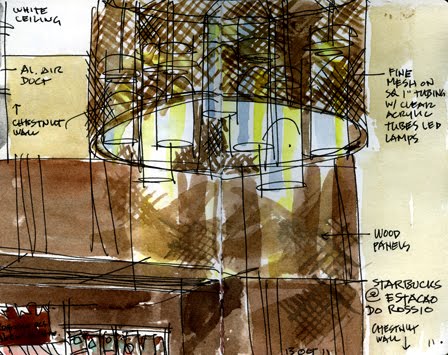
Estação do Rossio Star Bucks Interior, Lisbon.
This lavish train station's right entrance is the Star Bucks. Interior of this location seems more
theatical and bolder in scales on Lighting fixtures and glass partition between the station and the cafe.
Estação do Rossio
Looking more like a theater or a lavishly adorned palace with horseshoe arched doorways, this monumental Neo-Manueline building located between Rossio and Restauradores squares, was built at a time when train stations were seen as temples of technology.
The Franco-Swiss author Blaise Cendrars called railway stations 'the most beautiful churches in the world,' and this station could be an example. It is one of the strangest architectural complexes housing a rail terminal in Europe, and today it is the local station for trains to Sintra.
It was closed for over three years for major renovation, but reopened in February of 2008.
http://www.golisbon.com/sight-seeing/rossio-station.html

Museu do Design e da Moda (MUDE) - Lisbon 6
 Period design products by contemporary masters in fashion, furniture, household, automobile and major period iconic pieces.
Museu do Design e da Moda (MUDE) - Lisbon 5
 Period design products by contemporary masters in fashion, furniture, household, automobile and major period iconic pieces.
Museu do Design e da Moda (MUDE) - Lisbon 4
 Period design products by contemporary masters in fashion, furniture, household, automobile and major period iconic pieces.
Museu do Design e da Moda (MUDE) - Lisbon 3
 Period design products by contemporary masters in fashion, furniture, household, automobile and major period iconic pieces.
Museu do Design e da Moda (MUDE) - Lisbon 2
 Period design products by contemporary masters in fashion, furniture, household, automobile and major period iconic pieces.
Museu do Design e da Moda (MUDE) - Lisbon 1
 Museu do Design e da Moda (MUDE), address: R. Augusta 24, 1100 Lisboa, Portugal.
Located in the heart of the tourist central an old building with a post-war rustic renovation.
All the bare concrete slab, floor and plastered wall are left with marks of demolitions and spray
white/grey paintings like a Pollock painting.
Black marble snake counter to divided the space, the "black snake" with front lit verticals looks too finish but serves the idea and back drop for an industrial design museum.
To read more : http://www.mude.pt/
Museu Colecção Berardo, Interior - Lisbon 2
 Alexander Calder's sculpture turns the core of this entrance spiral staircase into a tree trunk, organic and playful.
Museu Colecção Berardo, Exterior - Lisbon
 The massive Museu Colecção Berardo exterior in blocks with offices and museums to created a
garden within a garden feeling to the space.
The presentation of the Berardo Collection Museum offers an overview, a panorama of the creation of plastic arts in the twentieth century and the beginning of the XXI century, particularly in European and American art. Reflecting all the richness of the history, styles, origins mediums and techniques of the works from the collection, and provides a journey through the modern and contemporary Portuguese artistic creation, focusing on its originality and the place it occupies on the international scene.
The Berardo Collection Museum offers visitors not only the richness of its permanent collection through a route regularly renewed, but also a wide range of temporary exhibitions that allow, a broadening of the scope of the collection and deepen certain problematic topics or approaches.
In 2009 the Museum carrys on this mission by presenting a series of temporary exhibitions, of which are highlighted in the second trimester, the Universal File - Document and Photographic Utopia, the first exhibition in Portugal of the Austrian artist Peter Kogler, a retrospective of the Portuguese architect Amâncio "Pancho" Guedes, another edition of PHotoEspaña and two shows of the Berardo Collection - a new path for modern and contemporary art, and an exhibition dedicated to the Art-Deco Collection.
Until the end of the year, the exibition Amália, will be Highlighted, the first major show devoted to one of the greatest players of Portuguese culture, in the year that will mark ten years since her death.
The Berardo Collection Museum offers visitors not only the richness of its permanent collection through a route regularly renewed, but also a wide range of temporary exhibitions that allow, a broadening of the scope of the collection and deepen certain problematic topics or approaches.
In 2009 the Museum carrys on this mission by presenting a series of temporary exhibitions, of which are highlighted in the second trimester, the Universal File - Document and Photographic Utopia, the first exhibition in Portugal of the Austrian artist Peter Kogler, a retrospective of the Portuguese architect Amâncio "Pancho" Guedes, another edition of PHotoEspaña and two shows of the Berardo Collection - a new path for modern and contemporary art, and an exhibition dedicated to the Art-Deco Collection.
Until the end of the year, the exibition Amália, will be Highlighted, the first major show devoted to one of the greatest players of Portuguese culture, in the year that will mark ten years since her death.
For more information click here: www.berardomuseum.com
If it is curiosity that stimulates the mind and induces the collector, the object of art he chooses out of his passion cannot be isolated from the expectations of a certain time, or of other people. In a way, the collector searches and brings together works of art that others would like to find and gather. Most of the time without knowing it, the collector turns other people’s dreams into reality. It is the relationship between one’s dreams and those of others that determines the destiny of any collection and ensures its place in the community.
The Berardo Collection is the result of an exercise in open-mindedness. We have made an effort to acquire works, which would illustrate, through their quality, the creative imagination of the artists. We do not accept any kind of limitation regarding movements, techniques or nationalities. On the contrary, we wish to keep these Collections open to the future and open to the public. Nevertheless visiting this site does not replace true contact with the work of art.
The site is an approximate illustration of the Collections - new artworks are being added - to remind people, and also myself that artistic creation is the human condition in its freer form. In the last three decades, friends, collaborators, consultants and writers have helped me collect these works of art following rigorous criteria.
I hope this Collection will inspire other Institutions and individuals to create and broaden collections, so that the coming generations may keep alive our days, our concerns, and our hopes through Art.
Joe Berardo
http://mirror.berardocollection.com/?ToplevelID=31&lang=en
Interior Of Caffe Taria - Lisbon
 Caffe Taria interior in Lisbon with a cigarette machine. The promotional poster on the machine was a rock climbing image and nature.
Brownie 2 - Bell From Arcosanti
 Acrylic painting on wood block.
Why Bell.
“If you had told me fifty years ago that I would build my activities from the proceeds of windbells, I would have said you were crazy.” - Paolo Soleri
Born in Turin, Italy on June 21, 1919, Paolo Soleri was awarded his Ph.D. with highest honors in architecture from the Torino Polytechnico in 1946. He came to the United States in 1947 and spent a year-and-a-half in fellowship with Frank Lloyd Wright at Taliesin West in Arizona, and at Taliesin East in Wisconsin. During this time, he gained international recognition for a bridge design displayed at the Museum of Modern Art and published in The Architecture of Bridges by Elizabeth Mock.
He returned to Italy in 1950 where he was commissioned to build a large ceramics factory, "Ceramica Artistica Solimene." The processes he became familiar with in the ceramics industry led to his award-winning designs of ceramic and bronze windbells and siltcast architectural structures. For over 30 years, the proceeds from the windbells have provided funds for construction to test his theoretical work.
Each year, Cosanti and Arcosanti metal and ceramic studios produce about 17,000 bronze bells and 5,000 ceramic bells. The proceeds from these bells go toward the overall running of the Arcosanti project and maintaining the Cosanti facilities.
Your contribution toward Cosanti Foundation through the purchase of bronze and ceramic bells is a valuable addition to the financial base.
http://www.arcosanti.org/project/support/bells.html

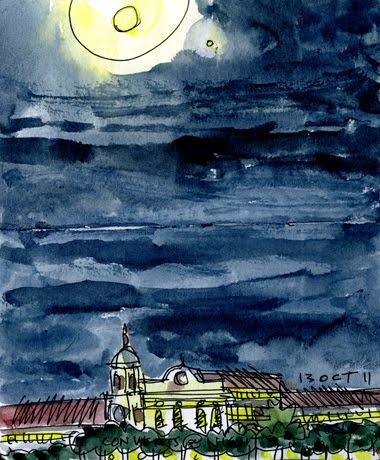
Pic-Nic Restaurant In Lisbon - IV
 A young girl and a young man both are fire-eaters performing in front of the patrons but busted by the police minutes later.


Pic-Nic Restaurant In Lisbon - I
 A restaurant close to the Praca do Rossio with 2 large led screens on sports to attracts the passer-by.
Praca do Rossio Lisbon area, or the Rossio Square, is one of the most beautiful places to see in Lisbon. The square, which is located in downtown Lisbon, has been a witness to various historical events in the city, from popular celebrations and revolutions to executions and bullfights. Today, Praca do Rossio is a popular destination both for locals and tourists. It is Lisbon’s main square, so it’s impossible to miss it when in the city.
http://www.top10portugal.com/praca-rossio-square-lisbon
Roof Of Hotel Vip Executive Suites Eden In Lisbon

Hotel Vip Executive Suites Eden is a beautiful 4-star property located in the heart of Lisbon, next to Praca do Rossio.
This Lisbon hotel has been built on an art deco building from the 1930's featuring 75 studios including double and 2 bedroom apartments.
The studios comprise a separated working area and feature modern facilities.
Hotel Vip executive Suites Eden has been classified as the Best Urban Renovation Project and the Best Tourism Project in Portugal.
Leisure facilities include swimming pool, solarium and bar on the terrace offering great panoramic views.
http://www.edenaparthotelvip.com/
Roof Details Of Monastery Of St. Jerome
 Ten minutes west of downtown along the banks of the Rio Tejo, the Belém district includes several of Lisbon's must-see sites. The 16th century Monastery of St. Jerome (Mosteiro de Jeronimos) is a must-visit; it teems with ornate stone carvings in the Manueline style (so named for King Manuel I who commissioned the monastery's construction to celebrate Vasco de Gama's seafaring voyage to India).
 http://travel.usnews.com/Lisbon_Portugal/Neighborhoods/
The church and the monastery, like the nearby Torre de Belém and Padrão dos Descobrimentos, symbolise the Portuguese Age of Discovery and is among the main tourist attractions of Lisbon. In 1983, UNESCO formally designated the Monastery of the Hieronymites and Tower of Belém as a World Heritage Site.
http://en.wikipedia.org/wiki/Jer%C3%B3nimos_Monastery
Cafe Gelo - King Carlos' Coach II

On the cafe wall a picture depicting the assassination of King Carlos and heir to the throne.
The cafe does a great selection of sweet items and serves hot and cold drinks too. They might sell savoury items too, but I cannot recall! Seating is available inside towards the back of the cafe and past the counters. Near the front, the cafe attracts quite a few customers who use the place as a takeaway.
The location us excellent too; just off the square near Rossio station. Despite the central location, the quality of food and prices are good and it's not just the usual tourist jaunt.
The cakes for example were all around 1 Euro each, which is pretty standard pricing for such cafes in Lisbon. Their range of bread rolls is particularly good and popular too.
http://www.travbuddy.com/Cafe-Gelo-v463822
Coaches Museum In Lisbon - King Carlos' Coach I
 One of Lisbon's most visited sights, the Coaches Museum (Museu Nacional dos Coches) has the largest and most valuable collection of its type in the world. It is housed in a richly decorated 18th century royal riding school that is part of Belem Palace, illustrating the ostentation and staggering wealth of the old Portuguese elite.
The detail of the coach that King Carlos & heir to the throne were killed in 1st. February 1908.
http://www.golisbon.com/sight-seeing/coaches-museum.html
Marquis Of Pombal Square In Lisbon
 Marquis of Pombal Square (Praça do Marquês de Pombal) Lisbon pays homage to the saviour of the capital in the form of the most central and busiest square of Lisbon. The Praça do Marquês de Pomball (Marques of Pombal Square) truly feels at the centre of Lisbon as three of the capitals largest boulevards extend in opposite directions and the main metro interchange station lies hidden below.
The monument dedicated to the Marques of Pombal stands commandingly in the centre of the square facing Baixa which was re-constructed under his vision but unfortunately the monument is encircled by unending traffic. The Praca do Marques de Pombal appears completely unappealing during the day while chocked by traffic, noise and fumes but return here later, as part of an evening walk, and the allure of the area returns.
The Praca do Marques de Pombal is situated right in the heart of Lisbon with the Avenue Liberdade, the Avenue Duque de Loulé and the Avenue Fontes Pereira de Melo all radiating in opposite directions of the capital. The main Avenue Liberdade leads down the gentle hill to central Baixa and it is quiet fitting that the Marques de Pombal statue faces towards his Baixa.
The statue was constructed between 1917 and 1934 and was inaugurated in 1934 as part of the republics building campaign to promote Portuguese self confidence by focusing on the achievements of the country.
http://www.lisbonweekendguild.com/lisbon-sights/Marquis_Pombal_Square.html

Houses On The Hill Of Castelo In Lisbon
 A view from the hotel balcony to the hillside of the Castelo.
Corner Detail Of São Carlos Theater in Lisbon

It was built in the 18th century in Neoclassical style after the original great Lisbon opera house in Comercio Square was destroyed in the Great Earthquake.
The exterior was inspired by Milan's La Scala, and the beautiful interior (with excellent acoustics) is similar to the San Carlo Theater in Naples, with five galleries and boxes adorned with neoclassical and Rococo decorations.
There is a very pleasant restaurant with tables on the pavement outside.
http://www.golisbon.com/sight-seeing/sao-carlos-theater.html
Waiting Area In Pearson Airport Terminal 3
 An hour delay at the airport, the gate filled with all the passengers.
The Hideout Wall Mural - 2
 The changing exterior mural have an octopus as the main theme of this rock hub.
Toronto has an incredible concentration of talented musicians, and we’re glad to say that many of them grace our kick-ass stage on a regular basis. The Hideout is a huge supporter of indie artists, hosting festivals such as NXNE, CMW and Indie Week each year since we’ve opened. But our focus is music, so even when the festivals have left town and the dust has settled, we are still rocking out our stage seven nights a week - check us out anytime, you won’t be disappointed.
http://www.thehideouttoronto.com/
The Chefs' House On King East
 A corner of the training school restaurant.
The Chefs' House - Learning Is Our Main Ingredient
The restaurant is the first of its kind in Canada – fully open to the public with students training to cook, bake and serve.
Housed in a 3,200 square foot heritage brownstone, the new restaurant serves up one-of-a-kind dining experiences to the city’s food lovers while providing George Brown Chef School students with the latest in real-world culinary training.
The Chefs’ House is an urban culinary retreat; a contemporary space that is used to profile and celebrate the bounty of locally grown food products and pay homage to the international cuisine that influences Toronto’s culinary scene.
http://www.georgebrown.ca/thechefshouse/index.aspx#TCH
http://www.thechefshouse.com/
Wall of the MacDonalds On Spadina And Queen West
 Red walls and black and white wall murals filled the upstairs seating area.
Corner of Spadina and Queen West
 The web of trolley cables gridded the sky with a group of yellow traffic lights to mark this busy
intersection.
A Corner In Grano On Yonge Street
 A Corner In Grano with Italian design posters, painting and murals.

Subscribe to:
Posts (Atom)